

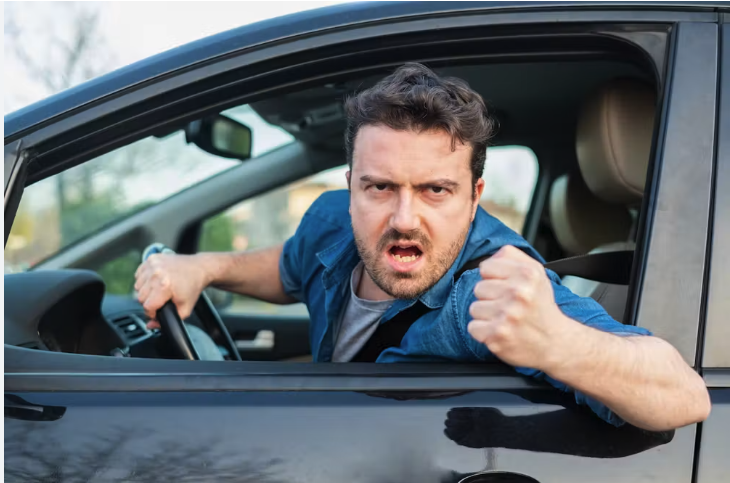
The 25-Second Enemy
I was on the on-ramp doing everything right. Signal on, coming in with the flow of traffic, not trying to cut a single person off. If you want to know how to control road rage, this is where the lesson starts.
The on-ramp lane was running out the way they always do, narrowing down to nothing, and what’s left at the end of it isn’t road — it’s the shoulder, with the glass and the bolts and whatever else lives out there.
So, somebody has to let me in. That’s not me being aggressive. That’s just how merging works. It’s heavy traffic. Nobody’s going anywhere fast. Letting me in costs you exactly one car length and zero seconds of your life.
And one car after another wouldn’t do it.
You know the move. They stare straight ahead. They get this look of intense concentration about the bumper in front of them, because if they glance over and catch your eye, now they’ve seen you, and seeing you means they must decide, and deciding means they might have to be the one who lets you in.
So, they don’t look. They pretend the entire driver’s side of their car has gone dark.
And you’re sitting there going, I know you see me. I am four feet away from you. You see me.
And they inch forward anyway.
So now I’m mad. Of course I’m mad. How much time do you think you’re saving? We are all stuck here together. Let me in.
And underneath it, the thing that really lights you up: why do people have to be like this?
I teach this stuff. I’ve spent thirty-five years learning how to stay clear-headed in situations a lot more intense than a Tuesday merge.
And a guy in the slow lane made me forget all of it for a second.
So, before I tell you anything, understand that I’m not writing this from some calm place above the traffic. I was in it yesterday. I’m telling you what I do, not what I’ve transcended.
Road Rage: The Two Versions of the Same Anger
There are two ways this gets you, and most people only notice the first one.
The first is when somebody wrongs you. The merge stiff-arm. The guy who rides the off-ramp at full speed so he can blow past forty cars and then knife back in at the very last second, right in front of you, like the rules were for everybody but him.
The left turn cut across your nose while you’re still moving.
Somebody did something to you, and the wires light up, and now you want to do something back. Drive up next to them. Stare. Mouth something through the glass they can’t hear and wouldn’t care about if they could. Lay on the horn.
And there it is.
For the next twenty-five seconds, you are mortal enemies with a person whose name you don’t know, whose life you know nothing about, who has no idea who you are either.
Total strangers, locked in combat, over a lane.
The second version is sneakier, and it’s the one worth sitting with. It’s when somebody decides that you’re the problem.
You’re driving along. You don’t think you did anything wrong.
And suddenly there’s a guy on your bumper, flashing his lights, or he pulls alongside and he’s the one mouthing words, throwing a finger, and laying on his horn — because in his version of events, you wronged him.
You went too slow. You didn’t let him in. You did something, in his mind, and now he’s furious at you.
And what happens?
Same instant heat. Maybe worse.
Because now a stranger is sitting in judgment of you, deciding you’re a bad driver, a bad person, and you don’t think it’s justified. So, you match him. He’s angry, so you get angry right back. Learning how to control road rage starts with noticing how quickly a stranger can pull you into a fight you never intended to have.
Here’s the question worth asking, though, and it stings a little: if you really didn’t do anything wrong — why does it bother you?
Why does a stranger’s horn get under your skin if you’re sure you’re in the right?
The anger is the tell. Some part of you is in there arguing the verdict, trying to win an acquittal from a man you will never see again in your life.
And here’s the part nobody likes: in that second version, you’re not the victim of the story. You’re the other driver.
You are the guy in somebody else’s “you would not believe this jerk I dealt with today” story.
You’ve been that guy more times than you’ll ever know, and you didn’t feel like a jerk even once, because you were sure you were in the right.
Just like the man on your bumper is sure right now.
How to Control Road Rage: What I Said to Myself on the Way to the Range
So back to me, sitting there, lit up, nobody letting me in.
I want to be honest about how this actually goes, because it’s not noble and it’s not instant.
The first thing that happened was the anger. I didn’t skip that part. I’m not built different. The wires fired and I was hot.
But here’s the one thing I’ve got, and it’s the only thing I’m really trying to hand you.
I keep a few phrases in my head. Not because I’m wise — because I know that without them, I’ll lose the moment. They’re not complicated.
And the one that did the work yesterday was about where I was actually going. For me, learning how to control road rage has less to do with suppressing anger and more to do with remembering what I was actually trying to accomplish.
I was on a break. I was driving to the range to hit a bucket of golf balls. That was the whole mission.
So somewhere in the heat I heard myself go: In fifteen minutes I’m going to be hitting golf balls, and that matters to me a lot more than this does. I’m not even going to remember what this guy looks like. I couldn’t pick him out of a lineup an hour from now. My objective right now is to get to the range and hit better than I did last time. This has nothing to do with that. Not one thing.
And then: You know what? He’s not letting me in. Fine. Let me just get in behind the next guy.
And I did. And I was okay with it.
That’s it. That’s the whole technique. It’s embarrassingly small.
But notice what it isn’t — I didn’t talk myself into forgiving him. I didn’t decide he was secretly a nice person having a hard day. He might be a jerk. He might be a jerk tomorrow too.
I didn’t judge his character at all because his character was never my assignment.
I just remembered what I was actually doing with my afternoon, and the anger had nothing left to stand on.
Because that’s the thing about the rage — it only moves into the house when the objective moves out.
The second you forget what you’re trying to do, emotion takes the wheel, and you’ll sit in it as long as it wants.
The instant you remember the objective and notice this isn’t in service of it, there’s no room left.
The objective is the whole game. Name it, and the anger starves.
The Thing My Driver’s Ed Teacher Knew
I learned the deeper version of this when I was fifteen, and I didn’t know at the time it was about anything bigger than a car.
My driver’s ed teacher told us: do your best driving, anticipate that other people won’t, and never assume everyone out there is going to do it right.
My father told me the same thing, in his own words.
You can’t hold every other driver accountable. You hope they’re good. You plan as if they’re not.
Because at the end of the day you are the only person responsible for the safety of you, your passengers, and your vehicle. That responsibility doesn’t get shared out to the road. It’s yours.
That’s defensive driving.
And it took me a long time to realize it isn’t really about driving. That may be one of the simplest lessons in how to control road rage: you cannot control the other driver, but you can control what you do next.
You don’t get to require strangers to meet your standard. Not on the freeway, not anywhere.
You can hope people are considerate. You can wish they were better.
But the second your safety, you’re day, your peace depends on other people behaving the way you think they should — you’ve handed the wheel to everybody but yourself.
Defensive driving says the opposite.
It says: I expect that people will fail, I plan for it, and I keep myself safe anyway.
Not because I approve of the bad drivers. Because being safe is my job and being right is nobody’s.
So, there are really two moves happening, and you need both.
One of them deals with the emotion — that’s restating the objective, talking yourself off the ledge.
The other one keeps you safe — that’s the actual defensive driving, the eyes up, the space cushion, the assumption that the guy beside you might do something stupid.
One keeps your head clear. The other keeps your car intact.
They’re not the same move, and you don’t get to skip either one.
And my driver’s ed teacher had the come-down move too, the one that sounds like nothing.
When somebody does something to you out there, he said, just wave. Or nod. Doesn’t matter what they did.
Throw up a hand, give a little nod, and let it go, and get back to driving well.
I used to think that was weak. It isn’t.
A wave isn’t you surrendering.
A wave is you refusing to get into the fight at all — staying safe, staying clear, and declining the invitation to become someone’s twenty-five-second enemy.
If it turns out you were driving badly, fine — work on getting better. That’s on you too.
And if you’re sure you didn’t do anything wrong? Also fine.
Wave, and move on.
Either way the move is the same, and either way it’s yours to make.
Twenty-Five Seconds, All Night Long
Here’s what finally got me to take all this seriously.
The merge itself lasts twenty-five seconds.
The honk, the cut-off, the finger through the glass — call it half a minute, tops, and then that person is gone from your life completely, forever, never to be seen again.
But that’s not how long you carry it, is it? Knowing how to control road rage also means knowing when the incident is over—even if your mind wants to keep replaying it.
You carry it to dinner.
You can’t wait to tell somebody about the jerk who wouldn’t let you in, the guy who cut across four lanes, the lunatic who honked at you for no reason.
It becomes a story. It becomes a bit you do.
And telling it, you get to feel the whole thing again — the indignation, the rightness, the heat — and now this stranger who had twenty-five seconds of your actual life is getting two more hours of it tonight, rent free, while he’s at home not thinking about you at all.
The interaction was free. The retelling is what’s expensive. And you’re the only one paying.
So, here’s the choice, and it’s a real one.
You can belabor it — carry it to dinner, run it back for your friends, hand a stranger another evening of your attention he never earned.
Or you can leave it with him.
Let him be the one preoccupied with something that has zero consequence, while you go on and have your afternoon.
Because at the end of all of it, what was the objective?
Get from point A to point B, safely, in one piece, without losing your head.
That’s the whole job.
Getting mad at a stranger doesn’t get you there one second faster, doesn’t make you one degree safer, and doesn’t fix a single bad driver on the road.
It’s not in service of the objective.
Nothing about it is.
So, the next time the lane runs out and nobody will let you in — and it’ll happen, probably this week — see if you can catch yourself in the heat and ask the only question that’s ever actually helped me:
what am I really trying to do right now, and is this it?
In fifteen minutes, you’re going to be somewhere that matters more.
You won’t remember his face.
You barely do already.
A Quick Road Safety Reminder
If you’re working on how to control road rage, the safest response to an aggressive driver is to avoid engaging, create space, and stay focused on getting where you’re going safely.
For more information on aggressive driving and road safety, visit the https://www.nhtsa.gov/risky-driving/speeding