

Take something you believe about yourself:
I'm disorganized.
Now watch what two different people do with that same belief.
The first person says, “I'm disorganized, which makes me a screwup.”
Done. Case closed. The judgment has been attached to the observation, and now there is nowhere to go.
The second person says, “I'm disorganized. My job requires me to be organized. So do I build that skill, or do I partner with someone who already has it?”
Then they do one of those two things.
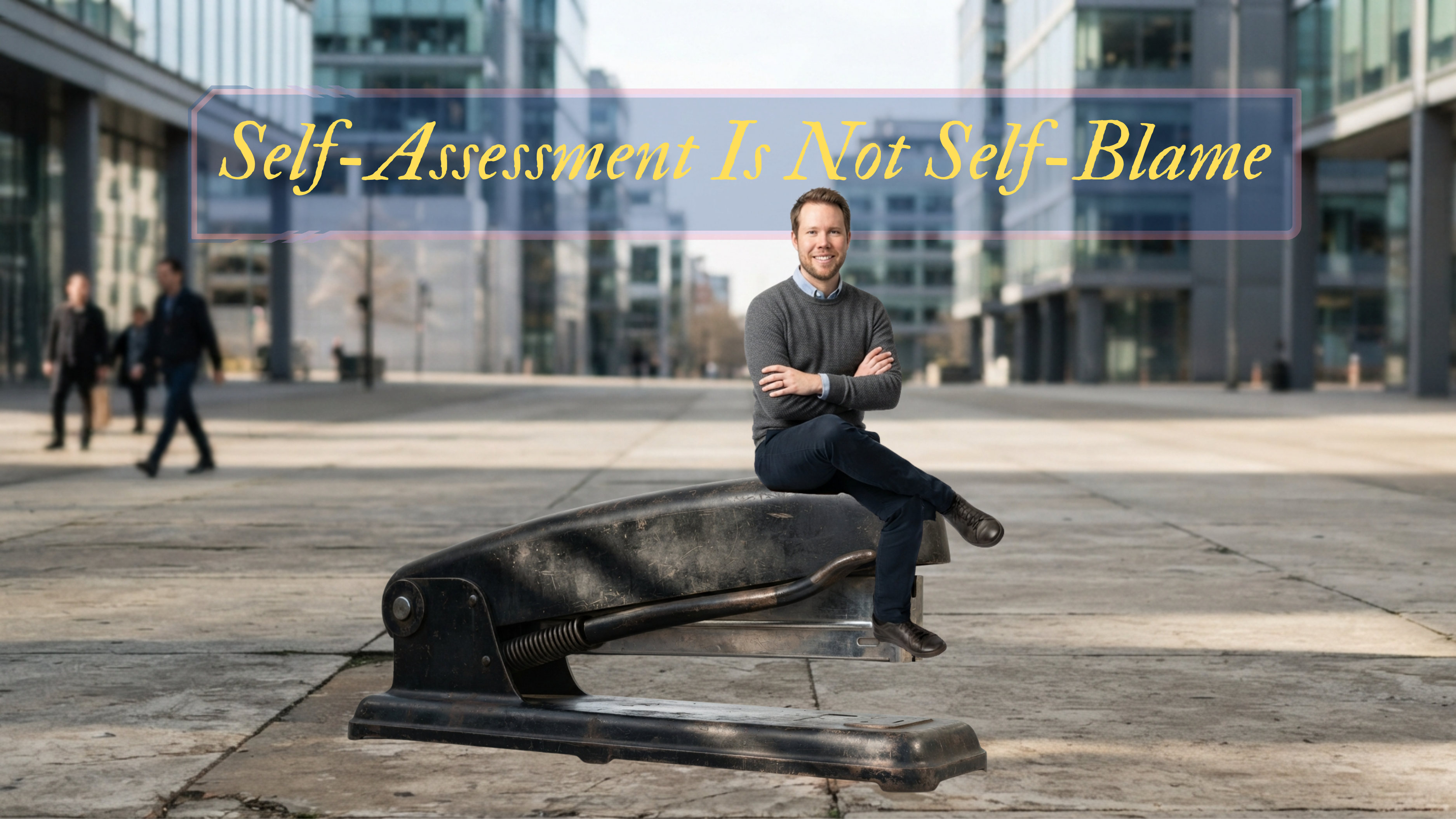
Same starting point. The disorganization didn't change. Nothing about the person changed in that moment. The only thing that changed was whether a verdict about their worth got stapled to the problem. And that staple can be the difference between a person who moves forward and one who stays stuck.
I have spent more than three decades teaching martial arts, and I have watched this distinction play out thousands of times. On the mat, mistakes are immediate. You drop your hands, you get hit. You move the wrong direction, you lose your balance. You hesitate, the opportunity disappears.
You get very good at seeing the difference between what happened and what someone decides that event means about themselves. That distinction matters just as much away from the mat.
The Staple
Blame works by stapling. It takes something that happened:
· You missed the deadline.
· You snapped at your kid.
· You froze when someone challenged you.
· You said something in a conversation you wish you could take back.
Then it staples on a second clause:
· And that makes me a bad person.
· And that means I can't do this.
· And that proves there's something wrong with me.
The first part is information. The second part is a verdict. And verdicts don't tell you what to do next.
You can sit with them. You can replay them. You can punish yourself with them. You can carry them around for years. But they don't point toward a next move. They point at you.
Assessment is what remains when you pull the staple out. Assessment is evaluation without the verdict.
Instead of asking:
What does this make me?
you ask:
What happened here, and what needs to change?
One of those questions gives you something you can work on tomorrow morning. The other one just hurts.
Most of us reach for the staple because somewhere along the way we started grading ourselves like finished products.
A finished product can only be judged. It's done. You walk around it, inspect it, inventory the flaws, and give it a score.
But a work in progress doesn't need a final grade. It needs assessment. Every flaw you discover in something you're still building isn't evidence that the whole thing is defective. It's simply the next thing to work on.
My instructor handed me that frame decades ago, and I've been handing it to students ever since:
Work in progress. Not finished product.
It sounds almost too simple. Until you watch what it does to someone who just took a clean shot to the face.
What I Said on the Mat
I've lived some version of this moment hundreds of times. A student is sparring. They get hit—clean, square, the kind of hit that rings them a little—and suddenly they stop. Their hands drop. Their posture changes. You can almost watch the confidence leave their body.
And what comes out of their mouth is often some version of:
· “I suck.”
· “I can't do this.”
· “What am I even doing here?”
Notice what just happened. The event was:
I got hit.
Within seconds, the student turned that event into a conclusion about who they are or what they are capable of. I suck is not an assessment of the punch. It is a judgment of the whole person. I can't do this takes one moment and turns it into a prediction about the future.
Neither one contains a next move. A student standing in “I suck” has stopped training, even if they're still standing on the mat.
So I don't argue with the feeling. I do three things.
1. Name the event. “You got hit.” That's it. Not, “You got hit because you're slow.” Not, “You got hit again.” Just the event, cleanly stated, with nothing stapled to it. You got hit. True. Survivable. Nothing else attached.
2. Find the mechanism. “Your hands dropped when they faked low.” Now we're somewhere useful. The hit wasn't a referendum on the student's worth. Their guard came down at the wrong half-second. That's not a character flaw. That's a habit. And habits are built through repetitions, which means they can also be changed through repetitions.
3. Course-correct. “So what do we build?” Hands stay up when the feint comes low. Let's drill it. The student gets back in. We work the actual problem. The next time someone fakes low, the hands stay where they belong. Not because the student decided to become a better person. Because they identified the mechanism and trained it.
Name what happened. Find the mechanism. Course-correct.
That whole sequence can take fifteen seconds. The verdict version—I suck. I can't do this. What's wrong with me?—can take an hour. And at the end of that hour, nothing has been trained.
Off the Mat
Away from the martial arts school, there usually isn't an instructor standing next to you. A conversation goes badly.
· Someone says something that hits a nerve.
· You become defensive.
· You shut down.
· You raise your voice.
· You agree to something you didn't want to agree to.
· Or you walk away and replay the conversation for the rest of the day.
There's nobody in your corner saying, “Stop. Let's look at what actually happened.”
So eventually that job becomes yours.
The lesson from the mat isn't that a conversation is a fight. It isn't. The lesson is that the same discipline we use to examine mistakes under physical pressure can help us examine our reactions under emotional pressure.
Instead of asking, “What's wrong with me?” ask:
· What happened?
· What was I reacting to?
· Why did it bother me?
Now we're assessing. The alarm bell that tells you you've moved from assessment into blame is often the moment your thinking goes global.
Assessment is specific:
When they said, “We need to talk,” I assumed something was wrong before the conversation even started.
Blame is global:
What is wrong with me?
Assessment examines an event. Blame indicts a person. When you catch yourself turning one event into a whole-person verdict, that's the moment to stop and pull out the staple. Go back to what actually happened. Find what is yours to work on. Then work on that.
Why Blame Is the Lazy Option
There is an obvious objection to all of this:
· If I stop blaming myself, am I just letting myself off the hook?
· Doesn't guilt prove that I care?
· Isn't being hard on myself the responsible thing to do?
No.
Blame is the lazy option. It feels rigorous. It feels like you're holding yourself to a high standard. It can even feel morally responsible. But look at what blame actually requires of you afterward.
Nothing. A verdict closes the file.
Once you've decided, “I'm a screwup,” there's no homework. No drill. No next repetition. You've paid the toll in self-punishment and walked away having changed exactly nothing.
Blame is the cheap version of responsibility.
It buys you the feeling of accountability without requiring the work of fixing anything.
Assessment is more expensive. Assessment asks you to remain in the discomfort long enough to understand what actually happened. Then it hands you a job. That's harder. That's the point.
It takes more humility to say, “I contributed to this. I need to understand how. And I need to work on it,” than it does to punish yourself with, “I'm terrible at this.”
One creates change. The other creates pain and calls it progress.
My instructor framed two qualities we need in training as Heart and Humility. Heart is perseverance.
It's the willingness to keep course-correcting. To stay engaged with the process when improvement becomes frustrating, slow, or uncomfortable.
Humility is the willingness to see your own shortcomings clearly without needing to defend them—and without turning them into an indictment of yourself.
Humility works because it begins with a simple assumption: I'm not finished.
If you're still a work in progress, finding something that needs improvement isn't evidence that you have failed. It's evidence that you're still building.
Vanity Gets in the Way
There is another word I've come to understand differently over the years: Vanity.
We tend to think vanity means showing off. Someone admiring themselves in the mirror. But vanity can be much quieter than that. It can simply mean becoming preoccupied with what other people think of us.
And that's exactly why vanity can interfere with honest self-assessment. When something is genuinely still under construction, you don't have to pretend it's perfect.
You can say:
· I've started this. What am I missing?
· How could I make this better?
· What do you see that I don't?
There's less image to protect because you've already decided the work isn't finished. But when we treat ourselves like finished products, every flaw feels threatening.
If I'm finished, then the flaw doesn't represent something I can improve. It represents something wrong with the product. So I defend it. Hide it. Explain it. Or blame myself for it.
Treat yourself as a work in progress and the relationship changes. Feedback doesn't have to be an attack. A weakness doesn't have to become an identity. A mistake doesn't have to become a verdict. It can simply become information about what comes next.

The Dead End Is the Information
Imagine you're moving through a maze and you reach a dead end. The wall isn't a judgment. It doesn't tell you that you're bad at mazes. It tells you something very useful: Not this direction.
Thirty seconds ago, you didn't know that. Now you do. That's progress. The dead end gave you information.
If you run the maze blaming yourself every time you encounter a wall, eventually you'll spend more energy judging yourself than finding the exit. But if each dead end becomes information, every wrong turn narrows the search. That's what assessment does.
A mistake can tell you:
· Don't do that again.
· Try this differently.
· I need more practice here.
· This is something I need help with.
You don't have to enjoy discovering the flaw. You just need to be willing to use the information.
That's where Heart comes back in. You continue course-correcting. Again and again. Because a work in progress is supposed to change.
For the Person Who Is Already Too Hard on Themselves
There is one group of people who may hear everything I've said and take it in exactly the wrong direction.
If you're the person who automatically assumes everything is your fault—the person who takes on more than your share and scans yourself first whenever anything goes wrong—assessment does not mean taking responsibility for everything.
Noticing your part in something is not the same as deciding the entire thing was your fault. You can examine your behavior honestly without taking ownership of someone else's.
You can say:
· Here's what I did.
· Here's what I would change.
· And this other part belongs to them.
Assessment requires honesty in both directions. Own what is yours. Work on what is yours. And don't staple someone else's behavior to your worth either. Then put down what doesn't belong to you.
For many of us, the recurring problem is that we never get to that kind of specific assessment at all.
We move from “Something went wrong” straight to “Something is wrong with me.”
And once we've reached the verdict, we've stopped asking the questions that could actually help us change.
The One Question
I still catch myself doing it. Something goes sideways and I can almost feel the staple coming: “And that makes me a…” before I've even stopped to examine what happened.
The goal isn't to never feel disappointment, embarrassment, frustration, or regret. Those feelings are information too. The skill is learning to catch the moment when the feeling starts becoming a verdict. Then pull the staple out.
The next time you've taken a shot—from a difficult conversation, from a mistake, from a decision you wish you had made differently—and you feel yourself beginning to grade the whole person because of one event, ask yourself one question:
Am I a finished product, or course-correcting a work in progress?
Because you're not finished. None of us are. And the flaw you just discovered isn't the thing that ends the story. It's simply the next thing you can work on.
The fact was information. The verdict was something we attached to it. And the staple was never necessary.