

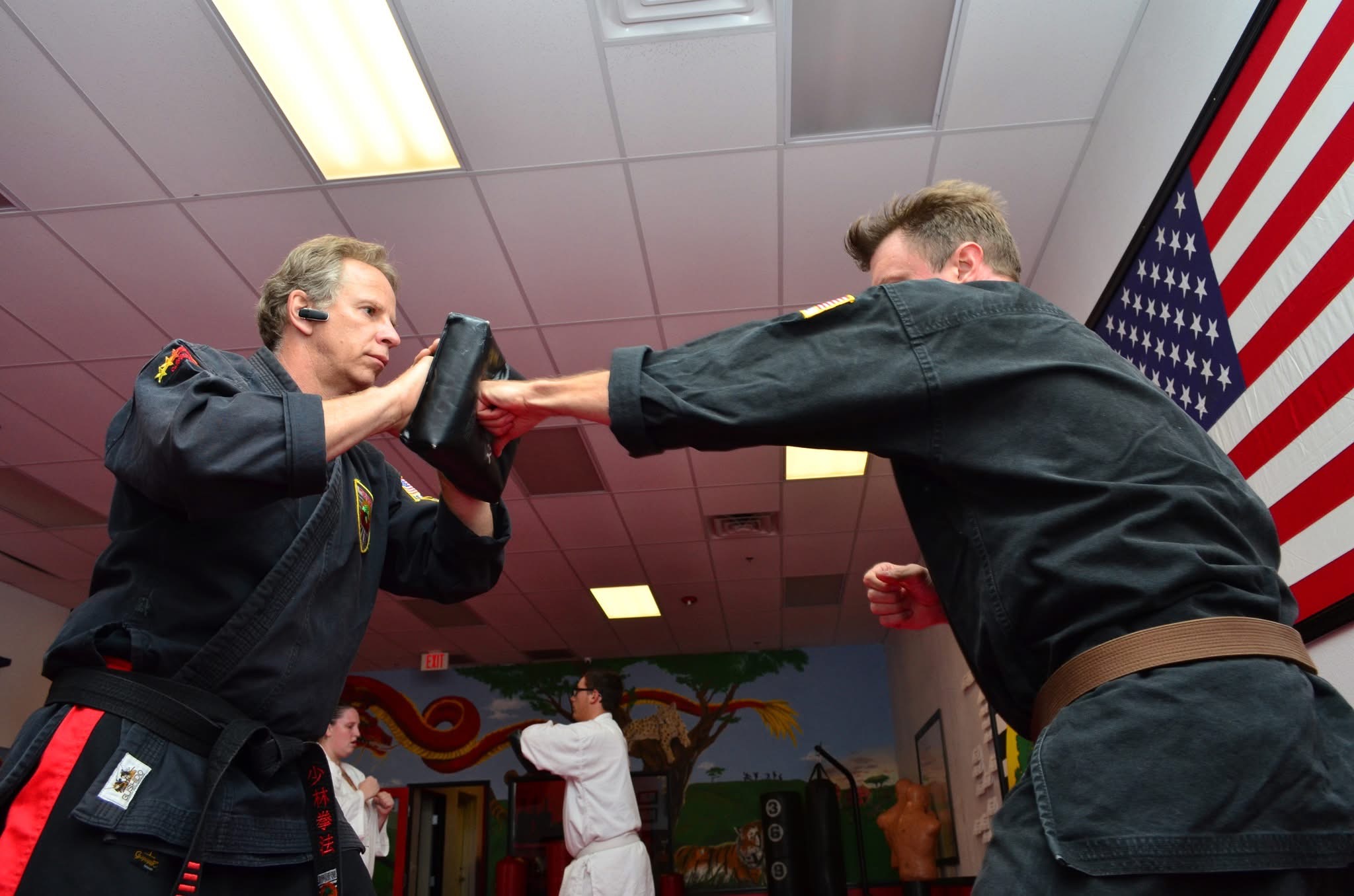
There was a stretch when I’d walk into the training room and pray we weren’t sparring that day. I didn’t know it then, but that room would teach me more about how to deal with difficult people than almost anywhere else.
Because sparring meant there was a chance I’d be paired with one man, and being paired with that man meant going home with bruised ribs, a jaw that ached for two days, forearms and shoulders that felt like they’d been worked over with a bat. He hit me harder than anyone in that room, and he hit me on purpose. I’d lie in bed cataloguing where it hurt. I dreaded the call to spar the way some people dread a dentist’s chair.
I was fourteen years old. I weighed about a hundred and fifteen pounds.
And here’s the part that made the whole thing worse: I’d walked into that room thinking I was good. I’d just won the adult black belt division — sparring and forms — competing against grown men, and I’d taken it. Back then a black belt was hard to come by, and I’d earned mine young enough that the man who ran our school had to grant me special permission to test. He’d also let me into the instructors’ workout — not the black belt class, the instructors’ class, the room where the people who taught the black belts trained. I came in certain I belonged there.
Let’s call the man who made me dread it Max. That’s not his name. He doesn’t get his name in this.
The Thing I Couldn’t See Yet
The other instructors in that room were, looking back, better fighters than Max. More skilled. More controlled. And almost all of them went easy on me. They’d spar a hundred-and-fifteen-pound high schooler the way you’d spar a kid — taking it as a kind of charity, letting me get something out of it, never really opening up. They could have hurt me any time they wanted. They chose not to.
Max chose the opposite. The man with less to teach than anyone else in the room hit me the hardest. I didn’t understand yet why that mattered. I just knew it as pain.
I was sure I knew why he did it. I was fourteen, I’d skipped a line he’d waited years to stand in, and he didn’t think a high schooler had any business in that room. So, every time we sparred, he made his case the only way he knew how — across my ribs, into my jaw. I tried to be respectful about it. Controlled punches, controlled kicks, the way I’d been taught. He didn’t return the favor. Not once.
When the Thing You’re Afraid of Turns Out to Be Real
Most of the time, when something like this is eating at you, the people around you talk you out of it. He doesn’t mean it like that. He’s just intense. You’re reading into it. You half-believe them because the alternative is worse.
So, one day I went to the man who ran the school, and I aired it out. I don’t really like Max, I told him. I think Max has it out for me. I think he’s jealous that I was promoted young, and he wants to put me in my place. I was building a case, justifying my way toward the thing I actually wanted, which was permission to never spar him again.
He didn’t talk me out of it. He looked at me and said: that’s true.
All of it. Max doesn’t like you. Max doesn’t think you belong in this room — he said so to my face. He doesn’t think a high school kid has earned the right to train with instructors. And then the part I wasn’t ready for: I told him to go ahead and show you. He as good as admitted he hadn’t discouraged a thing. He’d let it run.
So, there it was. The fear wasn’t in my head. The man really was trying to hurt me, and the person in charge had decided to let him. Nobody was going to argue me out of it. Whatever I was going to do about this, I couldn’t start by pretending it wasn’t happening.
Now What
I expected sympathy. What I got was a question.
“Okay,” he said. “He’s a jerk. He’s got a chip on his shoulder. That’s absolutely right.” And then, before I could even feel vindicated: “Now what? You think you’re going to become a good fighter sparring people who adore you?”
He was a man of few words, so that was most of the speech. But it reorganized something in me that’s stayed reorganized for thirty years. He’d conceded everything I came in with. Max was a jerk. Max did want to hurt me. I wasn’t imagining it, I wasn’t being dramatic, I was right. And being right turned out to be completely beside the point. The grievance was true, and it didn’t change a thing about what I had to do next.
I’d been so locked onto he doesn’t like me, I don’t like him, I want out that I’d never once asked the only question that could actually move me: what do I do about it? Not how do I make him stop. Not how do I prove he’s wrong about me. What do I do, right now, with the situation exactly as it is? That question became the foundation of how to deal with difficult people without needing them to change first.
The Water You Let In
There’s an old idea about boats that I keep coming back to. A ship doesn’t sink because of the water around it. The ocean is enormous and the ship floats in it just fine. A ship sinks because of the water it lets inside. Keep the water out, and there is no amount of ocean that can take you down.
Max was the ocean. His swinging at me, his wanting me gone, his chip on his shoulder — that was just weather. It existed whether I liked it or not, the same way the sea exists. I couldn’t litigate it. I couldn’t argue the water into being dry. The only thing in that entire situation that was mine was the hull. Whether I let any of it in. For me, that became another lesson in how to deal with difficult people: their behavior can surround you without having to get inside you.
For months I’d been taking on water. Every hard shot, every cheap one, I let inside, and I was sinking — not because Max was that good, but because I was bailing instead of sailing.
What My Own Mind Was Doing to Me
Here’s what the man who ran the school showed me next, and it’s the part that turned the idea into something I could actually use.
The fear and the anger weren’t just unpleasant. They were blinding me. I’d earned a black belt by learning to read people — to see a punch forming before it landed, to recognize the small tells that say what’s coming and move around them. That’s the whole skill. But when I sparred Max, none of it was available to me. All I could see was how much the last shot hurt and how much I hated him. The pain and the hatred fogged the glass. He wasn’t beating me because his moves were unreadable. He was beating me because I’d stopped reading.
And there was something underneath even that. Most sparring, if you’re honest about it, is a modified game of tag. Everyone’s throwing real punches and kicks, but nobody’s trying to hurt anybody — so some part of your mind knows the stakes are make-believe, and you stay loose, and you see clearly. Max made it real. He genuinely wanted to hurt me, and the moment I knew that for certain, my own mind changed the stakes. I can’t afford to get hit. And that — not his fists — is what beat me.
This is what the psychologists call appraisal: the same event lands completely differently depending on the meaning your mind assigns it. The punches coming at me from Max were no faster, no harder to read, than punches I’d handled a hundred times in that room. What changed was my appraisal of them. I’d decided they were catastrophic, and the catastrophe was the thing that took me apart. My own mind got in the way.
Once I understood that, the way through was almost simple to say. Get past the fear and the anger, and Max became as readable as anyone else. Clear the water out of the hull, and I could sail again. There’s a line I’ve carried ever since, and it’s truer than it has any right to be:
it doesn’t matter how hard the punch is if it doesn’t hit you.
Making Him the Teacher He Never Wanted to Be
So, I stopped bailing. Not all at once — I want to be honest, I didn’t wake up one morning enlightened. But slowly I stopped fighting Max with my feelings and started fighting him with my eyes. That was when I began to understand how to deal with difficult people without making their personality the center of the problem. I read him. And he turned out to be exactly as predictable as everyone else, maybe more, because arrogance makes a man reveal himself. There came a day when he couldn’t beat me anymore. Then there came a lot of those days.
Understand what Max wanted out of all this. He wanted me to cry. He wanted me to quit. He wanted me to slink back to whatever corner a high school kid was supposed to occupy and never grace that room again. Teaching me anything was the last thing on his mind — the man would have been horrified to learn he’d taught me the most valuable lesson of my early fighting life.
But that’s exactly what happened, and the distinction matters more than anything else in this article: Max didn’t give me that lesson. I took it.
He was the unwitting, unfitting instructor he never wanted to be, and he was an instructor only because I decided to make him one. The lesson wasn’t a gift. It was something I extracted from a man who’d have withheld it if he’d known he had it.
How to Deal with Difficult People: Why “He’s a Jerk” Is the Wrong Axis
Here’s the trap, and almost everybody I’ve ever met lives in it at some point.
It would not have mattered if Max found homes for stray puppies on the weekends. It wouldn’t have mattered if he did everyone’s taxes for free and ran bake sales for the whole school — for everyone except me. And it equally wouldn’t have mattered that he was, in fact, a jerk who wanted to hurt a kid. Good guy or bad guy is the wrong axis entirely. If you’re trying to figure out how to deal with difficult people, deciding whether they’re good or bad usually doesn’t tell you what to do next. Neither answer tells you a single thing about how to come through the situation unscathed, or how to come through it better than you went in.
When I decided “Max is a jerk, that’s the explanation, case closed,” what I’d actually done was hand myself permission to stop. He’s bad, therefore there’s nothing here for me, therefore I’m off the hook. That feels like a conclusion. It’s really just a place to hang your hat so you don’t have to keep working. And the cost of hanging your hat there is everything you might have learned if you’d stayed in the question.
Because the real question was never whether he was good or bad. It was: what’s my objective here, and what do I have to do to walk out of this better than I walked in? In sparring that question has a clean answer — read the person in front of you and find a way through.
But it’s the same question waiting inside every difficult person you can’t simply walk away from. The boss you’re not ready to quit on. The relative you’ll see at every holiday for the rest of your life. The coworker assigned to your project.
You can spend that whole relationship proving to yourself they’re a jerk — and you might be completely right — and being right will not move you one inch. Or you can ask what you need to do to get through it benefiting, and let their character be their problem instead of your prison. That, more than anything, is how to deal with difficult people when walking away simply isn’t an option.
I don’t need to walk you across the bridge to the difficult person in your own life. You were standing on the far side of it before you finished the first paragraph.
I Still Don’t Like Him
I got good enough that Max couldn’t touch me, and his ego couldn’t survive it. A grown instructor getting outpointed by the high schooler he’d been trying to break — there was no version of that he could live with. He started making excuses, started talking about how the place didn’t respect real fighters, and eventually he packed up and left on his own. The man who ran the school, I learned much later, had seen the whole thing coming and had his own quiet reasons for letting it play out. But that’s a longer story than this one.
Here’s where I’ll be honest, because I’m not interested in pretending to be a better man than I am. Thirty years later, I still don’t like Max. I think he was a pretentious, insecure jerk, and time hasn’t softened that. If I passed him on the street and recognized him, I would not stop to reminisce. And when he quit — when I turned out to be part of the reason he quit — I wasn’t gracious about it on the inside. I was glad. I was glad to see him go and a little glad I’d helped him to the door.
I’m telling you that on purpose, because the easy version of this article would end with me forgiving him, or being grateful to him, or hoping he found peace. I don’t, I’m not, and I don’t think about it.
What I took from him is genuinely one of the most valuable things anyone gave me about being a fighter and, it turned out, about being a person — and I extracted that lesson from someone I disliked then and dislike now, and both of those things are completely true at the same time.
That’s the whole point. Learning something from a person is different from liking them. Sometimes how to deal with difficult people starts with separating what they are from what you can still learn from them. It’s not absolving them, it’s not forgiving them, and it’s not rising above your own ordinary human reaction to them. You can keep your dislike. You can keep all of it.
The water stays outside the boat where it belongs — you just stop letting it in.
And the next time you’re stuck across from someone who’s hard to be around and happens to have something you need; the question isn’t whether they deserve your goodwill.
It’s what you’re going to walk out of that room having taken.